Physics
Lecture-1 | Units & Measurements
Subject
PhysicsStudent
Guest UserStatus
Not StartedTopic Content
Measurements:
A measurement involves comparison of given physical quantity with a standard measuring unit.
For example, for measuring the length of an object we need to compare it with standard length units of 1 meter, 1 foot, etc.
Standard unit:
A standard unit of measurement is a unit that is universally accepted and used for measuring quantities like length, mass, time, etc. These units are fixed and cannot be changed.
System of Units:
There are four types of systems for units are followed worldwide.
(i) CGS: Centimeter Gram Second system
(ii) MKS: Meter Kilogram Second system
(iii) FPS: Foot Pound Second system.
(iv) SI: System International
Fundamental Quantities and Units:
Fundamental quantities:
The physical quantities which do not depend on any other physical quantities for their measurements are known as fundamental quantities.
There are seven fundamental quantities
- length, mass, time, temperature, electric current, luminous intensity and amount of substance.
Fundamental units:
The units used to measure fundamental quantities are called fundamental units.
Fundamental quantity | SI Unit | Symbol |
1) Length 2) Mass 3) Time 4) Temperature 5) Electric current 6) Luminous Intensity 7) Amount of substance | meter kilogram second kelvin ampere candela mole | m kg s K A Cd mol |
Derived quantity:
The physical quantity which depends on fundamental quantities for its measurement are called derived quantities.
The derived quantities can be expressed in terms of the fundamental quantities.
Example: Area, Force, Velocity, etc.
Supplementary quantities and units:
There are physical quantities which are neither fundamental quantities nor derived quantities, such quantities are called as supplementary quantities and their units are known as supplementary units.
There are two supplementary physical quantities
- Plane angle (dθ)
- Solid angle (dΩ)
a) Plane angle (dθ): It is defined for a plane object , An angle made by a plane arc(curve) at its center is called as plane angle and it is denoted by (dθ).
It is defined as the ratio of length of arc to the radius of an arc.
\(\text{Plane Angle} (d\theta)=\frac{\text{Length of arc } (dS)}{\text{Radius of arc}(r) }\)
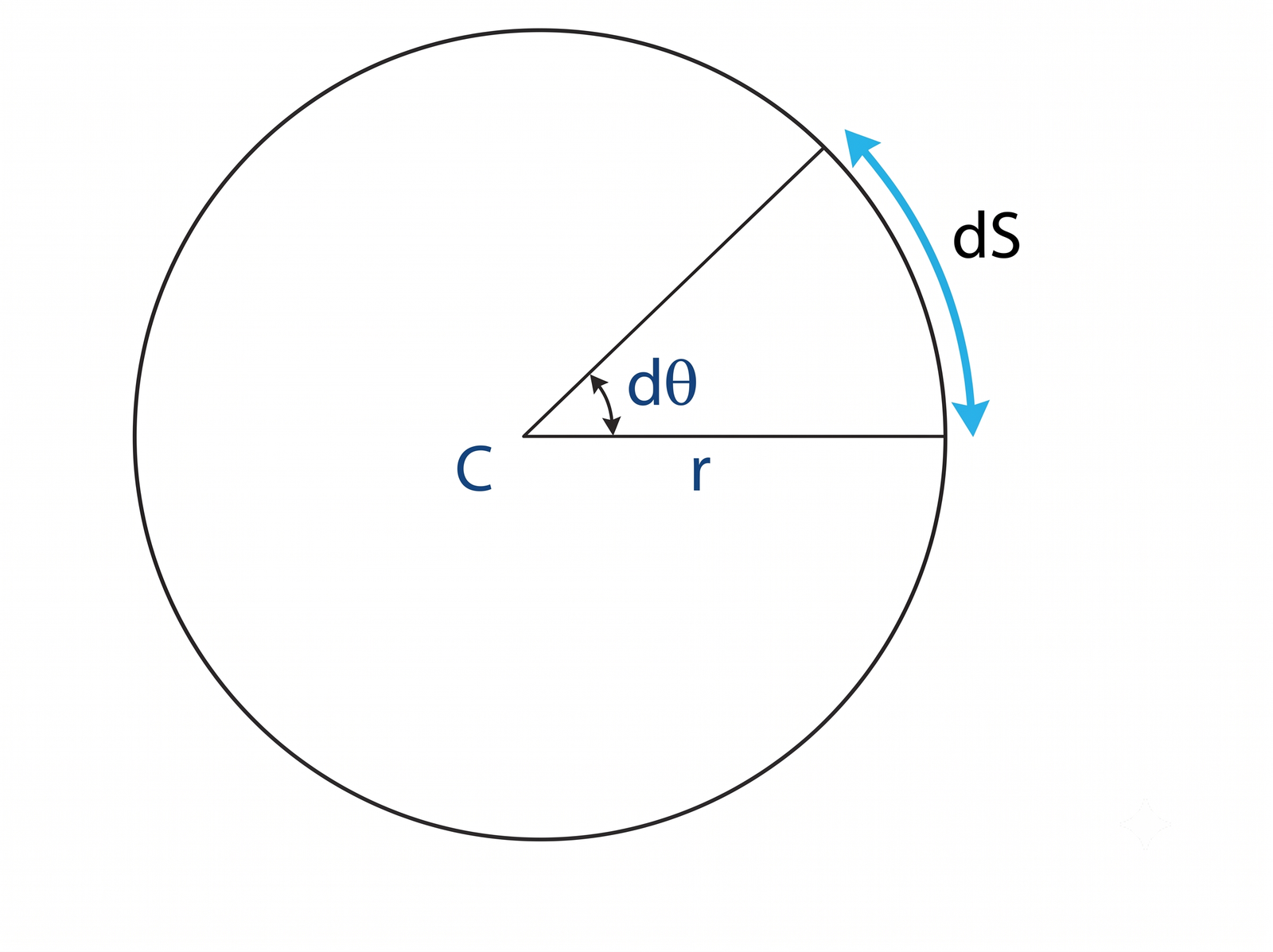
Unit for plane angle is radians or degrees
\(180^{0}=\pi\) radians
b)Solid angle (\(dw\)): It is defined for solid (3 dimensional) object
Angle made by a curved surface at its center is called as solid angle and it is denoted by (\(dw\)).
It is defined as the ratio of the area of curved surface to square of radius of the curved surface.
\(\text{Solid Angle} (d\omega)=\frac{\text{Area of curved surface } (dA)}{\text{Square of radius}(r^2) }\)
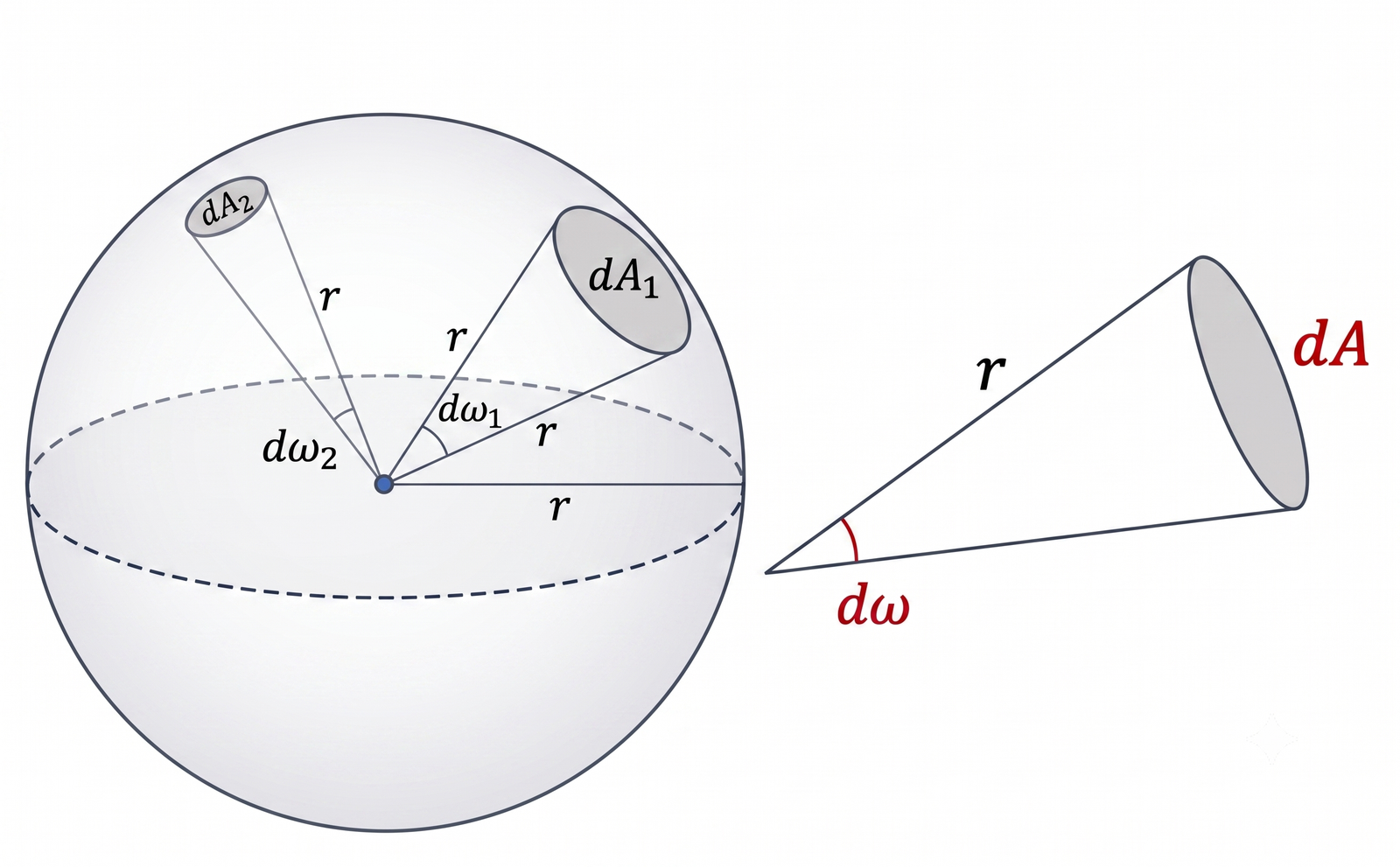
Unit of solid angle is steradian (sr)
SI units:
This system is used most widely and accepted worldwide. It uses decimal system, conversion within the system is very simple and convenient.
Conventions for the use of SI Units:
- Unit of every physical quantity should be represented by its symbol.
- Full name of a unit always starts with smaller letter and symbol of unit will be written in capital if it is bases on name of scientist (N for Newton, J for Joules etc.) otherwise in smaller letters.
- Symbols for units always written in singular form (100 N not as 100 Ns).
- Symbols for units do not contain any full stops at the end of recommended letter, e.g., 25 kg and not 25 kg.
- The units of physical quantities in numerator and denominator should be written as one ratio for example the unit of acceleration is m/s2 or m s-2 but not m/s/s.
- Combination of units and symbols for units not used when physical quantity is expressed by combination of two. e.g., The unit J/kg K is correct while joule/kg K is not correct.
- A prefix symbol is used before the symbol of the unit such as
\( 1m = 1 milli=10^{-3}\)
\( 1μ = 1 micro = 10^{-6}\)
\(1n = 1 nano=10^{-9}\)
- Space or hyphen must be introduced while indicating multiplication of two units.