Strength of materials
Beams | Introduction to Beams
Subject
Strength of materialsStudent
Guest UserStatus
Not StartedTopic Content
What is a Beam
A beam is a structural member that is generally placed horizontally and is designed to support loads acting perpendicular to its length (transverse loads). These loads create bending and shear within the beam.
Although beams are mainly subjected to transverse loads, they may also experience:
- Axial forces
- Torsional moments
- Thermal stresses
- Dynamic loading
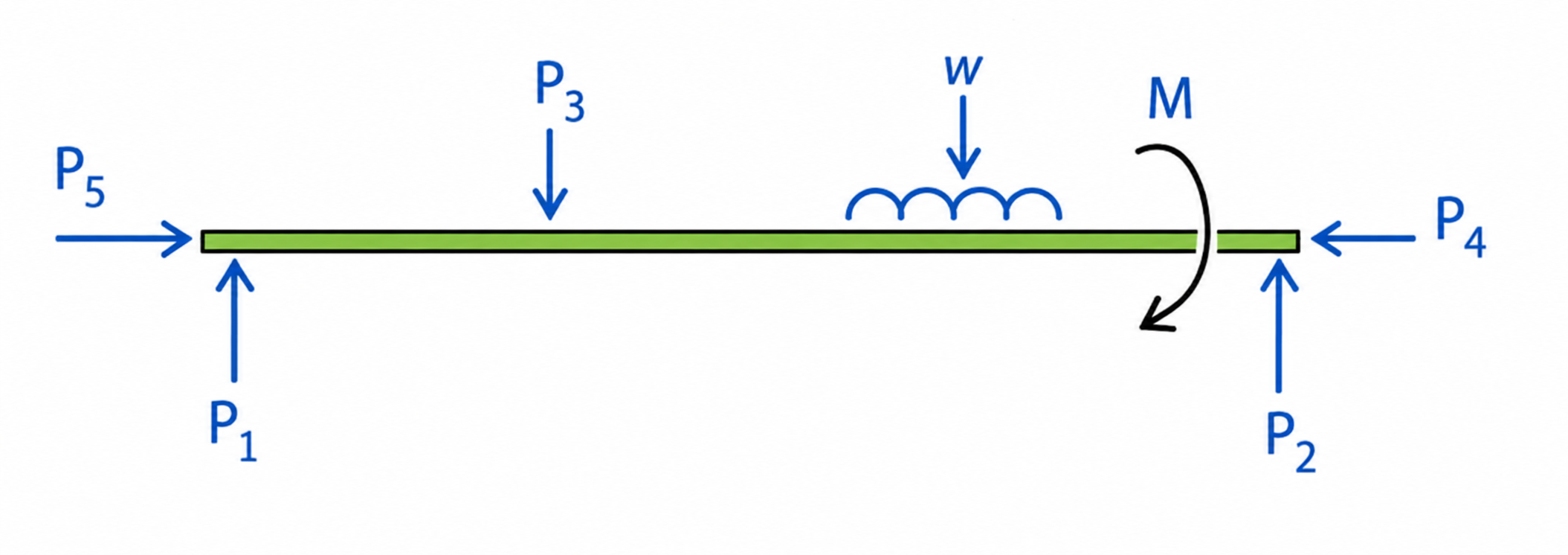
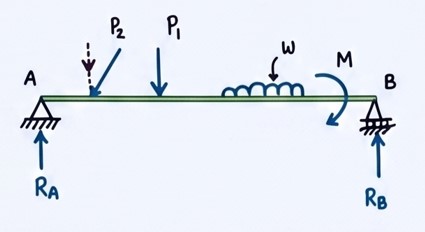
The given figure shows a beam with various types of loads acting on it.
Types of Beams (Based on Support Condition)
1) Simply Supported Beam
These beams are supported at both of its end points such that the vertical displacement of beam is prevented, but the rotation of beam about at least one support point is allowed.
• Pin–pin mixed load
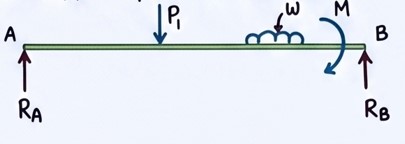
(The figure shows Simply supported beam with reactions \(R_{A}\), \(R_{B}\) point load \(P_{1}\) and \(P_{2}\) uniformly distributed load ‘w’ and applied moment ‘M’)
• Pin–roller simple FBD
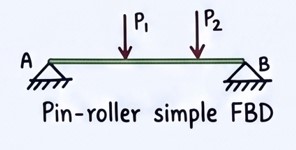
(Figure shows Pin–roller simply supported beam with point loads \(P_{1}\) and \(P_{2}\) )
• Simplified pin–roller point load
2) Cantilever Beam
A beam having fixed support at one end and other end is free is called a cantilever beam.
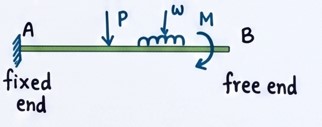
(Cantilever beam with fixed end at A and free end at B carrying point load P and UDL w, and moment M )
Since rotation of cantilever beam is prevented due to fixed support, there will be moment reaction acting at the fixed support.
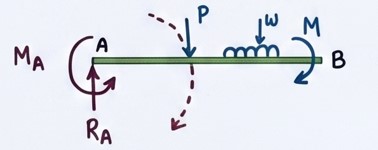
(Free body diagram of cantilever beam showing reaction \(R_{A}\), and \(M_{A}\))
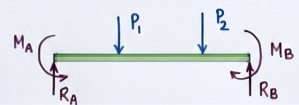
3) Fixed Beam
It is a beam having both of its end points fixed.
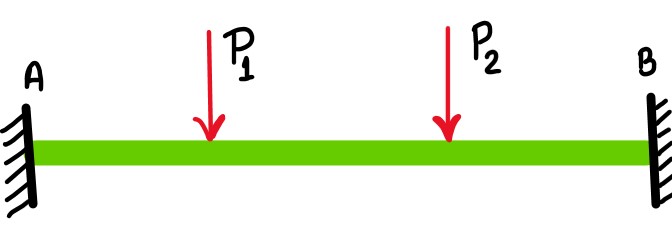
(Fixed beam carrying point loads \(P_{1}\) and \(P_{2}\))
• Free Body Diagram
4) Overhanging Beam
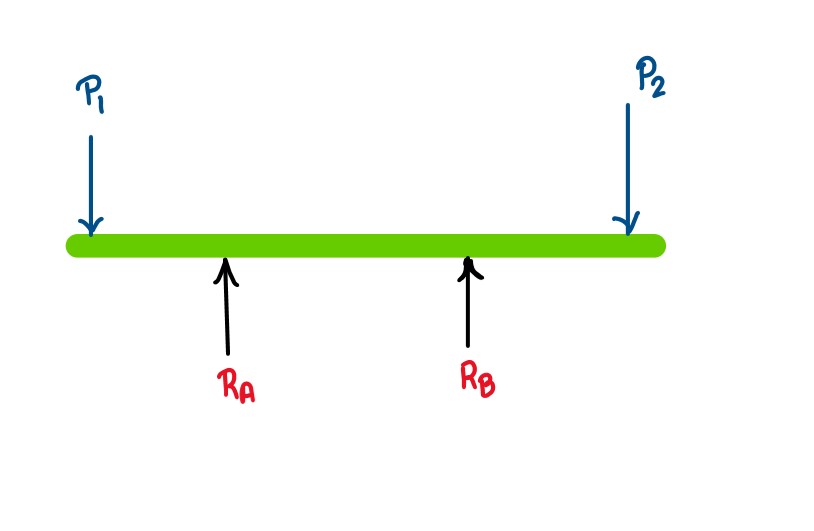
- It is an extension of simply supported beam.
(Figure: Single overhanging beam)

(Figure: Double overhanging beam)
Definition
- It is a kind of beam supported at two points (without preventing rotation) but having its one end or both ends free.
- It may be considered as a combination of simply supported and cantilever beam.
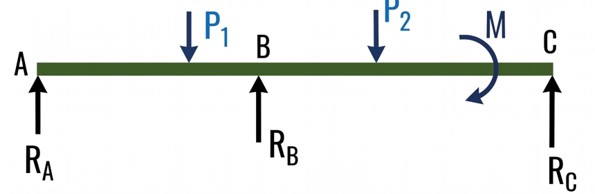
5) Continuous Beam
A beam having supports at more than two points are called as continuous beam.
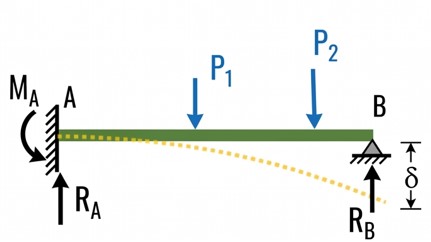
6) Cantilever Propped Beam
To prevent deflection of the free end of the cantilever beam, a support is provided at free end, such beams are called as cantilever propped beam.